FRIDAY, JUNE 5
On Friday, 5 June, the focus will be on the folklore of Lääne County and the islands.

HIGHLIGHTS
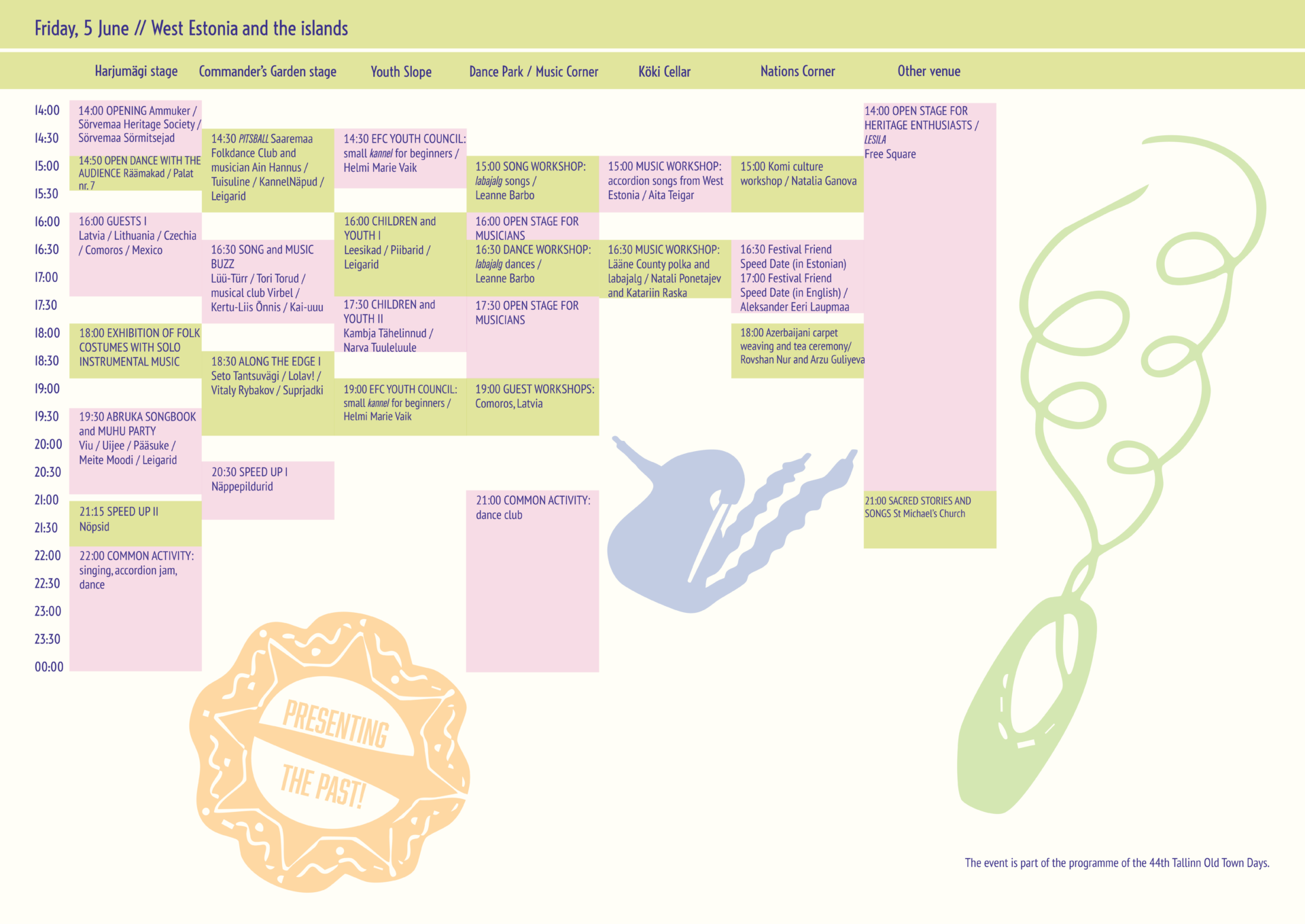
The Baltica Folklore Festival’s Capital Days are opening its gates for three days! Minister of Culture Heidy Purga, and Tallinn Mayor Peeter Raudsepp will greet the festival-goers. The festive atmosphere will be created by performers from Saaremaa: the Ammuker folk singing group from the Sörvemaa Heritage Society, the Sörvemaa Sörmitsejad instrumental ensemble and folk dance group.
We present to you the exquisite and exemplary folk costume ensembles of Estonia’s parishes, with musical interludes performed by soloists on the bagpipe, hiiu kannel (talharpa), kannel, violin, and accordion. With the help of folk costume masters, we will learn to appreciate the beauty and uniqueness of the details, thereby gaining a wealth of new knowledge about both the history and traditions of folk costumes.
At Rootsi-Mihkli Church, the door opens to a deeper and more timeless layer of folk tradition—where song is a way to create the world, to order it, to give it meaning, and to maintain a connection with the sense of the sacred within oneself and in the surrounding world.
The programme features songs and instrumental pieces that highlight the more timeless and contemplative side of folklore. The audience will have the opportunity to sing along to lyrical runic songs about the creation of the world and the star maiden, listen to folk-style choral tunes, and experience the church singing heritage of the Old Believers as well as the singing traditions of other peoples.
The songs and instrumental music will be performed by the runicsong group Ammuker, the Tähelinnud folk group from Kambja Ignatsi Jaagu School, the runicsong ensemble Väike Hellero, folk musicians from the Estonian Academy of Music and Theatre, the Nadežda ensemble of the Peipsi Old Believers’ Cultural Society, runicsong singer Urmas Kalla, the harp players from the ensemble Vormsi Talharpajad, kannel player Kertu-Liis Õnnis, and folk musician Kulno Malva on the accordion and bagpipes.
International guests at the Baltica folklore festival include the Czech folk ensemble Kuželovjan, the Lithuanian folk group Judlė, and the folk group from the Autonomous University of Querétaro in Mexico, the ensemble Mariachi Real de Santiago, and the trio Titanes Huastecos.
Programme curators: Marion Selgall and Eva Eensaar-Tootsen (Estonian Academy of Music and Theatre, traditional music programme). Producer: Krista Sildoja.
Entrance:
Free of charge (children aged seven and under and Baltica festival wristband owners)
7 € (discounted rate)
10 € (full rate)
20 € (family ticket: two adults and up to four children)
25 € (supporter ticket)
Tickets are available on Fienta and at the venue one hour before the start.

WORKSHOPS IN TRADITIONAL SINGING, DANCING AND INSTRUMENTAL MUSIC
The Youth Section of the Estonian Folklore Council invites anyone interested to a small kannel workshop to get acquainted with the instrument for the first time and start learning from scratch. Instruments can be borrowed on site, but if possible, please bring your own D-major small kannel to the workshop.
Instructor Helmi Marie Vaik
“Siit nurgast ja sealt nurgast, ai suskadi, kanarasvadi”—in this labajalg dance workshop, you’ll warm up your voice and get your feet moving. We’ll hand out handouts with clever and fun pronunciation exercises set to the rhythm of the dance.
Instructor Leanne Barbo
The Lääne County labajalg dances are lively, consisting of short, twirling steps that immediately draw the couple into a spin. Surely you’ve swung on a swing as a child or spun around holding hands with a friend and felt the joy of it! You don’t have to forget that same joy as you grow older—spinning in the labajalg isn’t half as wild as swinging on a swing, but the joy is at least just as great. And if your head starts spinning, you can keep dancing side by side in the meantime.
Instructor Leanne Barbo
We’ll explore the dance tunes characteristic of the historical regional traditions of Lääne County. We’ll learn to play a couple of authentic, old-fashioned polkas and labajalg tunes accompanied by the accordion and the Jew’s harp, which will get both musicians and dancers’ heads spinning with joy. You can participate with either a chromatic or a diatonic instrument. We’ll learn tunes in G, D, F, or C major, depending on the capabilities of the participants’ instruments.
Instructors Natali Ponetajev and Katariin Raska
The Youth Section of the Estonian Folklore Council invites anyone interested to a small kannel workshop to get acquainted with the instrument for the first time and start learning from scratch. Instruments can be borrowed on site, but if possible, please bring your own D-major small kannel to the workshop.
Instructor Helmi Marie Vaik
Take advantage of this unique opportunity to learn dance steps from around the world. The instructors are the Mbeningoma-Comores Association (Comoros), the Judlė folk ensemble (Lithuania), and Kuzelovjan (Czechia).

NATIONS CORNER
We invite everyone interested to discover the Komi culture through dance, games, and writing! We’ll learn a traditional Komi dance and play three fun folk games. In addition, we’ll introduce the ancient Komi Anbur alphabet, which dates back to the 14th century, and give you the chance to write your name in this historic script. The workshop is suitable for participants of all ages and requires no prior knowledge. Everyone who wants to experience something new is welcome!
Instructor Natalia Ganova
At this fun speed dating event, you can meet participants of the folklore festival—both on stage and in the audience. Maybe you’ll find a festival friend to attend performances and workshops with, or someone to wave to and wish “Break a leg!”?
Instructor Aleksander Eeri Laupmaa
At this fun speed dating event, you can meet participants of the folklore festival—both on stage and in the audience. Maybe you’ll find a festival friend to attend performances and workshops with, or someone to wave to and wish “Break a leg!”?
Instructor Aleksander Eeri Laupmaa
Experience Azerbaijan’s rich cultural heritage through the art of carpet weaving and a traditional tea ceremony. The workshop will be led by Azerbaijanis living in Estonia—carpet weaver and painter Rovshan Nur and Arzu Guliyeva, an Azerbaijani woman born in Estonia. Participants will have the opportunity to try their hand at basic carpet-weaving techniques and learn to interpret the meanings of patterns. The authentic Azerbaijani tea-drinking tradition will also be introduced, complete with sweets and explanations of customs.
Instructors Rovshan Nur and Arzu Guliyeva
In the Moroccan cultural tent, visitors can discover, photograph, and experience the authentic atmosphere of Morocco, explore traditional Moroccan decorations and interior design elements, and view an exhibition of traditional Moroccan clothing. A refreshment area is open, offering festivalgoers a chance to take a break and enjoy nourishment.
The tent also features a creative corner for children, where they can find inspiration from Moroccan folklore, patterns, and symbols for coloring and drawing. The children’s corner is open throughout the festival.

KNOWLEDGE STREET
In our tent, you can explore the rich world of folk costumes and get advice on how to make them skillfully. Throughout the day, we offer a variety of activities: advice on folk costumes; a demonstration of bobbin lace-making, with the opportunity to try it yourself; making beaded necklaces; braiding shoelaces and other ribbons.