SATURDAY, JUNE 6
On Saturday, June 6, we focus primarily on the folklore of South Estonia.

HIGHLIGHTS
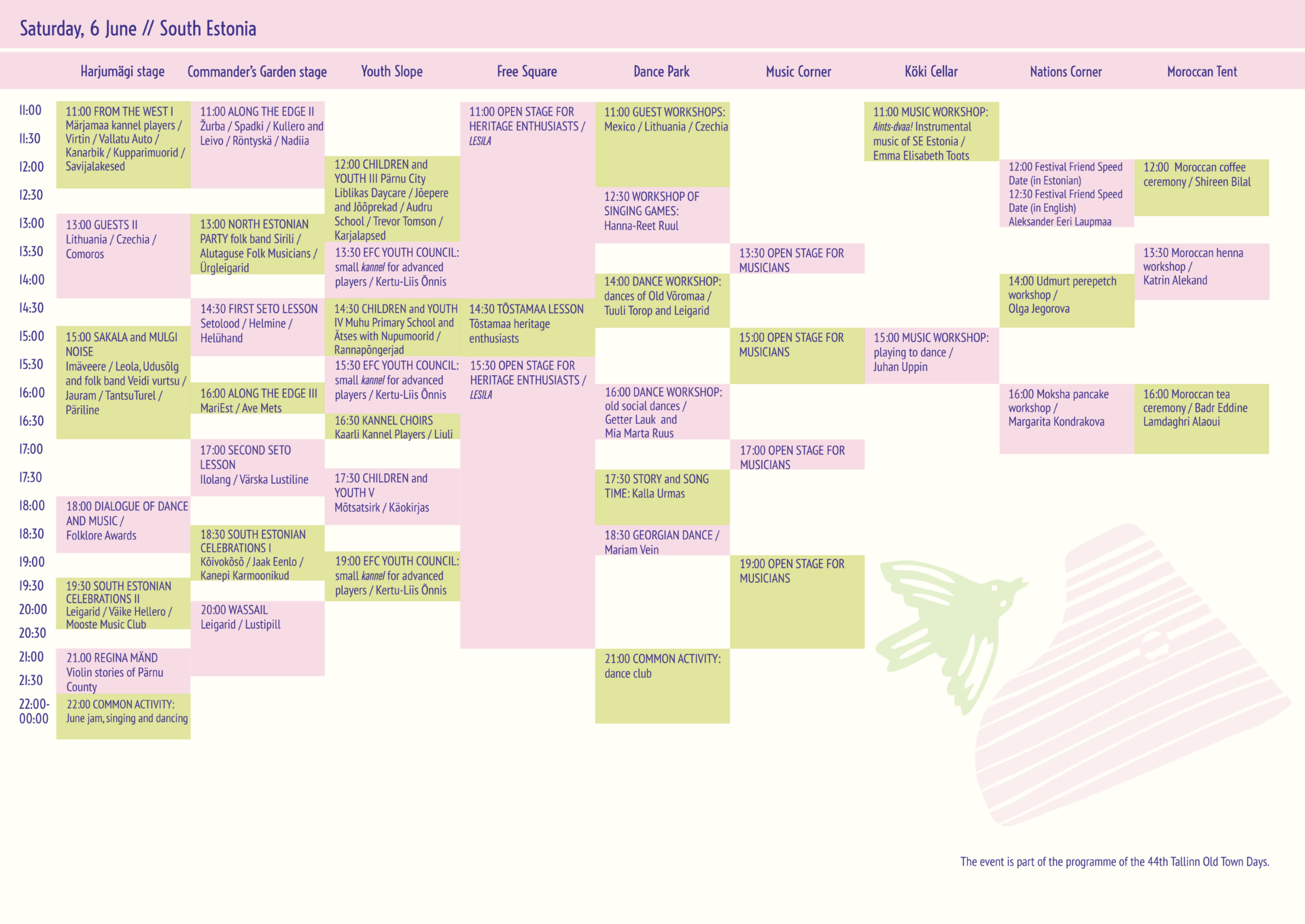
Each year, the Estonian Folklore Council honours individuals and groups whose conscious and dedicated efforts have made folklore visible and passed it on in an inspiring way. We honour the Instructor, Folklore Group, Organiser, Initiative, and Folklore Curator of the Year. Special recognition is given to the recipients of the PÄKU Heritage Culture Award, the Teotugi and the Torop Award. Between the award presentations, we will witness an exciting story of the ideal synergy—a dialogue—between dance and music that arises when a melody lifts a dancer off the ground, who in turn inspires the musician to play with ever-greater passion.
Folk musician and violinist Regina Mänd takes listeners on a journey to the rich and distinctive world of folk music in her home region of Pärnu County. This region has long been renowned for its village and wedding musicians, particularly its violinists. Regina brings the Pärnu County violin tradition to us not only through music, but also through stories and memories. You are welcome to come and listen, and to get up and dance! Regina Mänd received a special award from the Estonian Folklore Council at the Vabariigi Pillimees (Musician of the Republic) 2024 competition for her tradition-conscious and –sensitive playing.

WORKSHOPS IN TRADITIONAL SINGING, DANCING AND INSTRUMENTAL MUSIC
Take advantage of this unique opportunity to learn dance steps from around the world. The instructors are the folk dance group of the Autonomous University of Querétaro, Mariachi Real de Santiago and Titanes Huastecos (Mexico) and Kocis (Latvia).
This workshop takes participants on a one-hour journey into the unique world of Southeast Estonian folk music, introducing them to a repertoire that has historically been characteristic of this region. From the traditions of violin, accordion, and kannel music, the workshop will feature spirited kargus-kasatski and chastushka tunes, as well as some calmer dance music. Both diatonic and chromatic instruments are welcome.
Instructor Emma Elisabeth Toots
Playing! And singing! Isn’t that the secret to happiness? Singing games incorporate both dance and dramatic elements—whether it’s running through gates, turning into birds, or simply hopping and jumping around. You can sing and play at Baltica with Hanna-Reet Ruul, a folk musician from Võru County. Bring your good mood and an open mind! Singing along is highly recommended!
Instructor Hanna-Reet Pruul
The Youth Section of the Estonian Folklore Council invites interested participants to a small kannel workshop designed for experienced kannel players. Instruments can be borrowed on site, but if possible, please bring your own D-major small kannel to the workshop.
Instructor Kertu-Liis Õnnis
This workshop introduces the traditional dances of Old Võromaa, focusing on the wide variety of dance styles that were characteristic of the region. During the workshop, participants will have the opportunity to dance both familiar and less familiar dances, guided by the Leigarid.
Instructors Tuuli Torop and Leigarid
Given that modern Estonian folk music is predominantly dance music, this workshop will focus on how best to perform pieces from South Estonia in a way that suits their purpose. We will learn lesser-known versions of well-known dance tunes and, with a bit of luck, perhaps even something completely new. All instruments are welcome, but we will learn pieces in G or D major.
Instructor Juhan Uppin
The Youth Section of the Estonian Folklore Council invites interested participants to a small kannel workshop designed for experienced kannel players. Instruments can be borrowed on site, but if possible, please bring your own D-major small kannel to the workshop.
Instructor Kertu-Liis Õnnis
In this workshop, we’ll explore both well-known and lesser-known ballroom dances that were a staple of dance parties at the beginning of the last century. The workshop serves as a great warm-up for the dance club in the evening, as many of these dances still hold a prominent place in today’s dance clubs.
Instructors Getter Lauk ja Mia Marta Ruus
In the Georgian dance workshop, participants will learn the Adjaruli, a dance originating from the Adjara region of Georgia on the Black Sea coast. It is a joyful dance, the movements of which initially mimic the swaying of ocean waves but quickly transform into a pantomime depicting the daily activities of Adjarian women, such as making cheese or spinning wool. Adjaruli is a colorful, humorous, and lively dance that leaves everyone with a smile on their face by the end.
Led by the Georgian dance studio Juta, Mariam Vein, Tamara Vepkhvadze and Giorgi Rohelsaar.
Instructor Kertu-Liis Õnnis
The Youth Section of the Estonian Folklore Council invites interested participants to a small kannel workshop designed for experienced kannel players. Instruments can be borrowed on site, but if possible, please bring your own D-major small kannel to the workshop.

NATIONS CORNER
Join us for an engaging introduction to Arab coffee traditions, covering preparation methods, cultural significance, and serving customs. Discover that coffee is so much more than just a drink! Guests will experience the sensory aspects of the coffee tradition and its role in social gatherings.
Instructor Shireen Bilal
At this fun speed dating event, you can meet participants of the folklore festival—both on stage and in the audience. Maybe you’ll find a festival friend to attend performances and workshops with, or someone to wave to and wish “Break a leg!”?
Instructor Aleksander Eeri Laupmaa
At this fun speed dating event, you can meet participants of the folklore festival—both on stage and in the audience. Maybe you’ll find a festival friend to attend performances and workshops with, or someone to wave to and wish “Break a leg!”?
Instructor Aleksander Eeri Laupmaa
A hands-on workshop introducing traditional henna art and its cultural significance in different countries, civilisations and in Moroccan celebrations. Also, the background of the patterns and uses is elaborated. Participants will have the possibility to see, how henna is prepared. Participants will also be guided in creating simple patterns, and receive a small henna design from the artist as a keepsake. Participation fee 3 €.
Instructor Katrin Alekand
Perepetch are open-faced pies made from unleavened dough and filled with meat, mushrooms, or vegetables, topped with a mixture of egg and milk. This is an old traditional dish of Udmurt cuisine, served in honour of the most esteemed guests. The name comes from the Udmurt word peres’mon “old age”, because the folding of the dough’s edges resembles wrinkles. Once upon a time, these pies were baked only for funerals, then for celebrations, and today perepetch are the hallmark of Udmurt cuisine.
Instructor Olga Yegorova (Estonian Union of National Minorities)
Moksha millet pancakes are not just food—they are the living memory of a people, passed down from generation to generation. Their golden glow reflects the warmth of the sun, the generosity of the earth, and the spirit of ancient traditions. Each pancake as if holds within it a fragment of the warmth of home, family closeness, and hope for better future.
They are baked during life’s most important moments: when a new journey begins, when changes are celebrated, when people come together to share joy and support one another. Let’s step together into the Moksha world through its fragrant, delicious, and traditional cuisine.
Instructor Margarita Kondrakova (Estonian Union of National Minorities)
A cultural experience introducing the Moroccan tea ritual, a symbol of hospitality and social connection. Participants will discover the history, etiquette, and techniques of preparing and serving traditional mint tea, followed by tasting.
Instructor Badr Eddine Lamdaghri Alaoui
In the Moroccan cultural tent, visitors can discover, photograph, and experience the authentic atmosphere of Morocco, explore traditional Moroccan decorations and interior design elements, and view an exhibition of traditional Moroccan clothing. A refreshment area is open, offering festivalgoers a chance to take a break and enjoy nourishment.
The tent also features a creative corner for children, where they can find inspiration from Moroccan folklore, patterns, and symbols for coloring and drawing. The children’s corner is open throughout the festival.

11:00-19:00 KNOWLEDGE STREET
The Mulgi Culture Institute showcases and sells literature in the Mulgi dialect. Visitors can enjoy chatting in Mulgi and discussing topics related to preserving the Mulgi language and culture. There are fun word games and riddles for those interested. The Mulgi people will also be bringing local handicrafts and a few surprises.
The Võru County tent brings together the museums of Old Võromaa, the Old Võromaa Handicrafts Centre, and the Võro Institute. Vilve Oja teaches how to make embroidered belts, the Võro Institute offers exciting word games, and there is also Võro-language literature and local handicrafts on display.
In the tent of the Muhu Folk Costume Advisory Board, you can see both modern and traditional Muhu embroidery, as well as various heritage artifacts. We have tablet-woven belts on display, and visitors are welcome to try their hand at weaving them.